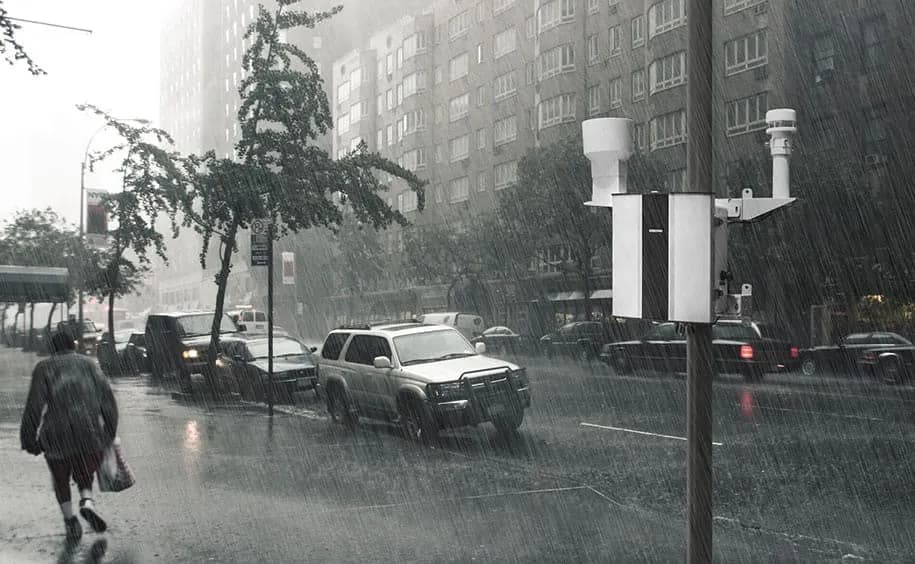
Sensors for continuous monitoring of meteorological parameters, essential tools for smart cities
20 June 2024
In the context of climate change and extreme weather events, access to precise, real-time meteorological data becomes a necessity.
In the context of climate change and increasingly frequent extreme weather events, access to precise, real-time meteorological data is becoming a necessity for cities aiming to protect their citizens and optimize urban services. Traditional weather stations, while accurate, are few in number and provide only regional-level data. Smart cities require denser networks of meteorological sensors that can capture hyperlocal conditions — street by street, neighborhood by neighborhood.
Applications in urban management
Compact weather stations like Oizom's Weathercom measure temperature, humidity, barometric pressure, wind speed and direction, rainfall, and solar radiation. When deployed across a city, they create a detailed meteorological map that supports a wide range of applications: flood early warning systems, urban heat island mapping, air quality dispersion modeling, energy consumption optimization, and agricultural planning in peri-urban areas.
For smart cities, the integration of meteorological data with other urban data streams — traffic, energy, air quality, public health — creates powerful synergies that enable more informed decision-making and more resilient urban environments.
Tags